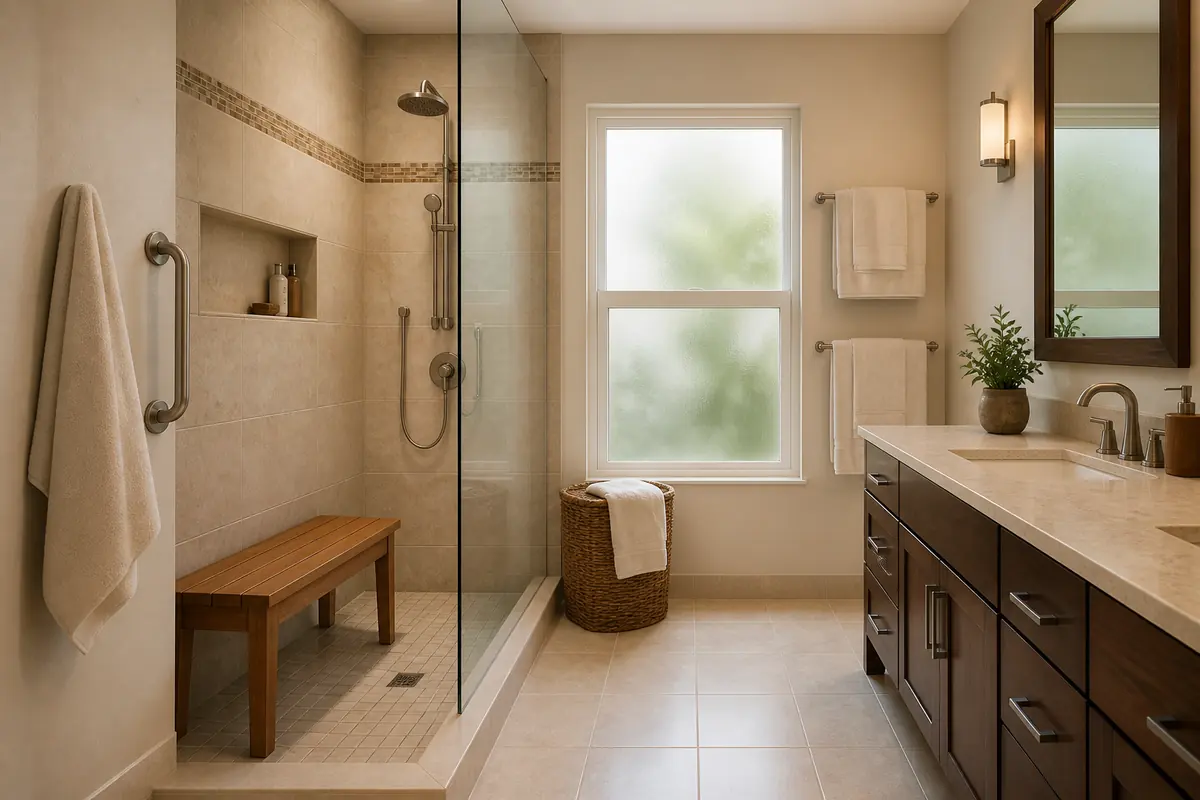
Falls are not an inevitable consequence of aging. Many risk factors can be identified and addressed, and occupational therapists are trained to consider how a person's abilities, routines, and environment interact. CDC guidance includes practical steps for reducing common hazards at home.
Here are five modifications that may be considered as part of an individualized home-safety plan.
1. Bathroom safety equipment
The first modification is bathroom safety equipment. Grab bars beside the toilet and inside the shower or bathtub can provide a stable handhold when balance is challenged. Unlike towel bars, grab bars should be selected and installed for their intended safety purpose. A tub transfer bench may allow someone with limited mobility to sit while moving over the tub edge. Non-slip surfaces can also address common bathroom hazards.
2. Better lighting
The second modification is better lighting. Inadequate lighting can make environmental hazards harder to see. Motion-activated night lights may help illuminate hallways, particularly between the bedroom and bathroom. Brighter task lighting may also improve visibility in kitchens, reading areas, and bathrooms.
3. Clearer walking paths
Third is the removal or securing of floor-level hazards. Area rugs that curl or slide can create a tripping hazard. Depending on the home and the person, an OT may recommend removing them or securing them with an appropriate non-slip backing. Electrical cords crossing walking paths should also be rerouted when possible.
4. Safer stairs
The fourth modification addresses stair safety. For any home with stairs, a continuous, graspable handrail on at least one side — and ideally both — is essential. Many older homes have decorative rails that don't extend the full length of the staircase, leaving the first or last step unprotected. We assess rail diameter, mounting stability, and extension beyond the top and bottom steps to ensure they're truly functional. For individuals with significant stair difficulty, we evaluate the feasibility of a stair lift or single-floor living modifications.
5. Smoother thresholds and transitions
The fifth modification is threshold and surface transition management. Changes in flooring height between rooms — even very small ones — can catch the shuffling gait pattern common among older adults. Beveled transition strips between surfaces of different heights reduce this risk. Exterior thresholds, particularly at the front door where the step-up from porch or sidewalk can be significant, often benefit from a beveled ramp or low-rise step addition.
A whole-home assessment
Each of these modifications is most effective when implemented as part of a comprehensive home assessment conducted by an occupational therapist who can also evaluate the individual's specific balance, strength, vision, and medication profile. The home and the person must be considered together — because the goal isn't a safer house. It's a safer life.